
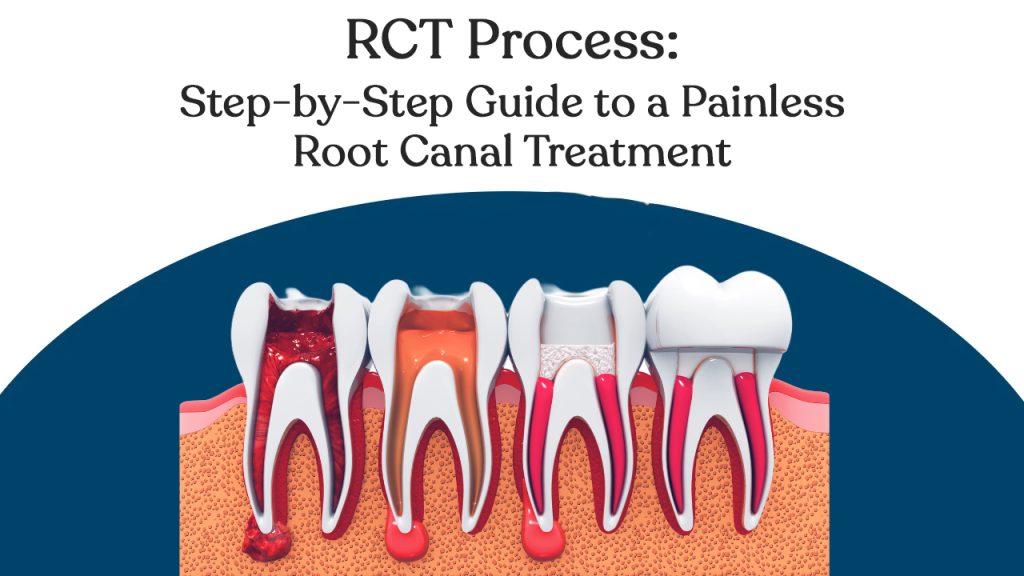
Did you also visit the dentist, and they recommended Root Canal Treatment? Maybe your tooth throbs when you bite down, or aches with anything hot or cold. Now the words “root canal” scare you more than the pain itself.
Here’s the truth: RCT saves your tooth instead of pulling it out, and it’s far less painful than the stories you’ve heard.
This guide, by Dr. Md. Javed Ahmad, our expert endodontist at Asian Dental, who has performed root canal treatments in Kondapur and Kukatpally for years, walks you through the exact RCT process, step by step: what to expect, and whether or not it’s really painless.
The Root Canal Treatment Process, Step by Step
A root canal treatment comes down to six steps, from the first X-ray to the finished tooth. Here’s each one, in the order it actually happens.
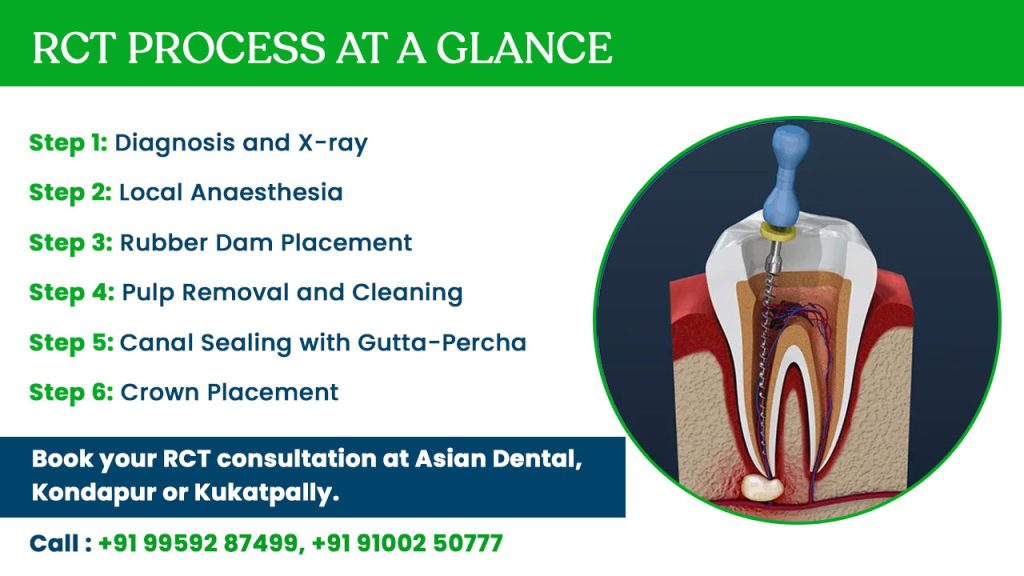
Step 1: Exam and X-ray
Your dentist takes an X-ray first, to see how far the infection has gone and whether the tooth can still be saved. Along with the X-ray, they may test how the tooth reacts to cold or heat. That tells them whether the nerve inside is still alive or already dead, which changes exactly how the rest of the treatment goes. This part doesn’t hurt at all. It’s the same as any routine dental X-ray you’ve had before.
Step 2: Numbing the Tooth
Local anesthesia goes in next, numbing the tooth and the gum around it. This is the step people worry about most, and it’s also the one that makes the rest of the appointment a non-issue. Once you’re numb, you won’t feel the drill, the cleaning, or anything else that follows. The ache you came in with is from the infection, not from anything that happens next. Your dentist may also place a small rubber sheet, called a dental dam, over the tooth. It keeps the area dry and free of saliva while they work, which matters more for a clean result than it sounds like it would.
Step 3: Opening the Tooth
Your dentist makes a small opening in the top of the tooth to reach the infected pulp inside. If the tooth is badly broken down or cracked, they may need to remove a bit more of it first. This gets a clean, straight path to the pulp chamber. You’ll feel some pressure, maybe a bit of vibration, but not pain. If it still hurts at this point, more anesthesia goes in before continuing.
Step 4: Cleaning and Shaping the Canals
This is the longest part of the visit. The infected pulp comes out, and the canals inside the tooth get cleaned and shaped with thin instruments. Throughout this step, the canals also get flushed with a disinfecting solution, to kill off bacteria the instruments can’t fully reach on their own. For canals that are narrow or curved, Dr. Javed Ahmad works under a microscope for this step, which is what microscope-assisted RCT actually means in practice.
Step 5: Filling and Sealing
Once the canals are clean, they get filled with a material called gutta-percha and sealed shut. Gutta-percha doesn’t react with your body, which is why it’s been the standard filling material for root canals for decades. A thin layer of sealant goes in alongside it, closing off any gaps where bacteria could sneak back in.
Step 6: Restoration
A temporary filling goes on the same day, to seal the tooth until your next visit. A permanent crown or filling usually follows a few weeks later. By then, any soreness has settled, and your dentist can confirm the tooth is healing well.
Most root canals take one or two visits total, depending on how deep the infection runs when you come in:
| Infection Severity | Visits Usually Needed |
| Mild, caught early | One visit |
| Been hurting for weeks, or deeper infection | Two visits |
Cost for root canal treatment follows a similar pattern, since it depends on the tooth, not a fixed rate:
| Cost Factor | Why It Matters |
| Which tooth | Molars have more canals than front teeth, so they cost more to clean |
| Crown needed after | Adds to the total, separate from the RCT itself |
| Number of visits | More visits for deeper infections can add to the cost |
Is Root Canal Treatment Actually 100% Painless?
No, and any dentist who tells you that isn’t being fully honest with you. Here’s what actually happens instead:
- The numbing takes care of the drilling, cleaning, and shaping, so you won’t feel those parts happening
- Once the anesthesia wears off, mild soreness for a day or two is normal, not a sign something went wrong
- Regular pain relief handles that soreness fine
- Most people eat normally again within a day, just going easy on that tooth until the temporary filling settles
What root canal treatment does deliver is far less pain than the infection you walked in with, and far less than most people expect before they’ve actually had one done. That’s the honest version of a painless root canal treatment: not zero sensation, just far less than the fear promised.
Book Your Root Canal Treatment with Asian Dental in Hyderabad
Every root canal here starts with an exam and an X-ray. Patients often mention how clearly Dr. Javed Ahmad explains each step first, backed by sterilization and a numbing-first approach, what root canal treatment in Hyderabad should look like.
If a throbbing tooth won’t wait, call ahead so the team can try to fit you in the same day, whether that’s the Kondapur branch or Kukatpally. Both handle full root canal treatment in Kondapur and root canal in Kukatpally, from the first X-ray through the final crown. Root canal in Kondapur gets the same doctor and same exam as Kukatpally. A root canal treatment at Asian Dental starts with a same-day exam whenever possible, since pain like this rarely waits for a scheduled slot.
Searching root canal near me and just need the nearest working number? Both branches stay open all seven days, 10 AM to 9 PM. If cost is what’s actually holding you back, check this guide on root canal treatment cost in Hyderabad. It breaks down what changes the number before you even walk in.
Call Kondapur at +91 9959287499 or Kukatpally at +91 91002 50777 and get it looked at.
Frequently Asked Questions
How Many Visits Does Root Canal Treatment Take?
Most root canals take one or two visits, depending on how deep the infection runs. Doesn’t matter if you’re coming in for root canal treatment in Kondapur or root canal in Kukatpally: it’s your tooth that decides the visit count, not the branch.
Does Root Canal Treatment Really Not Hurt?
Not the way its reputation suggests. Most of the fear comes from old stories, not from anything that actually happens in the chair today. Modern anesthesia and modern instruments have changed root canal treatment in Hyderabad a lot since those stories started.
Do I Need a Crown After Root Canal Treatment?
Usually, yes, especially on back teeth that do a lot of chewing. A treated tooth can get brittle without one. Front teeth sometimes just need a filling instead.
What Happens If I Delay Root Canal Treatment?
The infection keeps spreading into the bone around the root, and a dull ache can turn into a swollen jaw or an abscess. Waiting doesn’t make the decision easier. It usually just means a longer treatment later, since Dr. Javed Ahmad often sees patients who could’ve finished in one visit end up needing two, simply because they waited. If you’re searching root canal near me at 1 AM with a tooth that won’t quit, that’s your sign to stop waiting, not keep searching.
Can a Treated Tooth Get Infected Again?
It’s rare, but it can happen if bacteria get back in through a cracked filling or a canal that got missed. That’s fixed with a re-RCT, which reopens and cleans the same tooth again. Regular checkups catch this early, whether you’re coming in for root canal in Kondapur or the Kukatpally branch.
How Much Does Root Canal Treatment Cost?
It depends on the tooth, how many canals it has, and whether you need a crown after. You’ll get an exact number after the X-ray, not before.