
You were told there are two ways to remove a troublesome tooth and now you are unsure which to pick. You want less pain, fewer stitches, and a quick return to work. You also need the option that is safest for your tooth position.
Here is the clear answer to the title. Zapping vs. Cutting describes two methods that achieve the same goal through different tools. Zapping uses a dental laser for light beam surgery on soft tissue and, in select cases, thin bone. Cutting uses a scalpel incision, a surgical flap, and drill-based bone cutting for mechanical extraction. Both are safe when matched to the case.
This guide is written by the oral surgeons at Asian Dental, widely chosen as the best dental hospital in Hyderabad and the best dental clinic in Kukatpally for wisdom teeth removal and minor oral surgery. We perform both methods and choose what fits your X-ray, comfort, budget, and timeline.
Quick Answer First: When To Choose Zapping Or Cutting?
If you want a minimally invasive approach with less bleeding and faster healing for soft tissue and simpler exposures, laser zapping often helps. If your tooth is fully impacted in dense bone or needs sectional removal, traditional cutting is usually safer and more predictable. We confirm the choice after an oral exam and X-ray or CBCT.
What Zapping Means In Dentistry?
Zapping uses a diode laser or soft tissue laser. The high-frequency beam allows contactless cutting with light coagulation that reduces bleeding and keeps the field clean. In selected cases the laser assists limited bone vaporization. This is part of precision dentistry and is typically minimally invasive.
Zapping Advantages
- Faster healing and shorter recovery.
- Less bleeding, minimal swelling, and reduced pain.
- Lower infection risk because the site is cleaner and often sterile.
- Contactless cutting with tidy edges and, in many cases, no sutures.
- Quick return to work and a smile-ready result sooner.
What Cutting Means In Dentistry?
Cutting is the traditional, time tested pathway. The surgeon makes a scalpel incision, reflects a surgical flap, removes bone with a drill, and completes mechanical extraction using elevators and forceps elevation. Teeth may need sectional removal. The site is closed with manual suturing.
Cutting Advantages
- Universal applicability for all tooth positions.
- Handles complex impactions and deep bony extractions reliably.
- Cost effective and widely available with standard equipment.
- Often covered by insurance in hospital settings.
- Supported by widespread training and surgical expertise.
Zapping vs Cutting: Procedure Differences You Will Notice
Both methods are safe in trained hands. The steps and feel are different.
| Step you notice | Zapping with laser | Cutting with scalpel and drill |
| Access | Contactless light beam | Scalpel incision and flap |
| Soft tissue | Soft tissue laser with light coagulation | Scalpel and instruments |
| Bone work | Selective bone vaporization in limited areas | Drill based bone cutting |
| Bleeding control | Coagulates as it moves | Suction, pressure, and sutures |
| Closure | Often sealed edges, sutures sometimes not needed | Manual suturing is routine |
| Visit type | Single visit laser in suitable cases | Standard surgical visit |
Wisdom Teeth Removal: Where Each Method Fits!
Zapping vs cutting, choosing the method depends on tooth position, bone density, and infection status.
Good fits for zapping
- Partially erupted upper wisdom teeth with inflamed soft tissue.
- Operculectomy or small soft tissue releases that need minimal swelling.
- Patients aiming for minimally invasive care and faster recovery.
Good fits for cutting
- Fully impacted lower wisdom teeth inside dense bone.
- Deep angulation and tricky roots that benefit from sectional removal.
- Cases that require firm mechanical separation and a predictable flap.
Zapping vs Cutting Suitability Criteria: A Simple Pre Surgery Checklist!
Your safety, recovery plan, and goals guide the choice.
| Question | Why it matters |
| What does the X-ray or CBCT show | Tooth position, bone density, and proximity to nerves |
| Is the tooth partially erupted or fully impacted | Partials often suit laser zapping; deep lowers suit cutting |
| Is there gum infection or inflamed tissue | Laser can reshape and coagulate soft tissue |
| What is your medical history | Bleeding and healing influence the plan |
| What is your recovery timeline | Return to work or travel plans affect method |
| What is your anxiety level | Local anaesthesia, sedation, or general anaesthesia can be planned |
| What is your budget and insurance status | Costs and coverage vary by method |
| Do you have cosmetic concerns | Laser edges can be neat in suitable cases |
Anaesthesia And Comfort Options
Both methods can be pain free with the right protocol. Most cases use local anaesthesia. Sedation is available for anxiety. Complex impactions in hospital settings may need general anaesthesia. Our aim is reduced pain, less discomfort, and a smooth visit.
Zapping vs Cutting Aftercare: What Stays The Same And What Changes!
Common steps
- Cold compress for the first day.
- Prescribed painkillers as directed.
- Salt water rinses from day two.
- Gentle brushing away from the site.
- Avoid smoking and hard or sharp foods.
Laser leaning differences
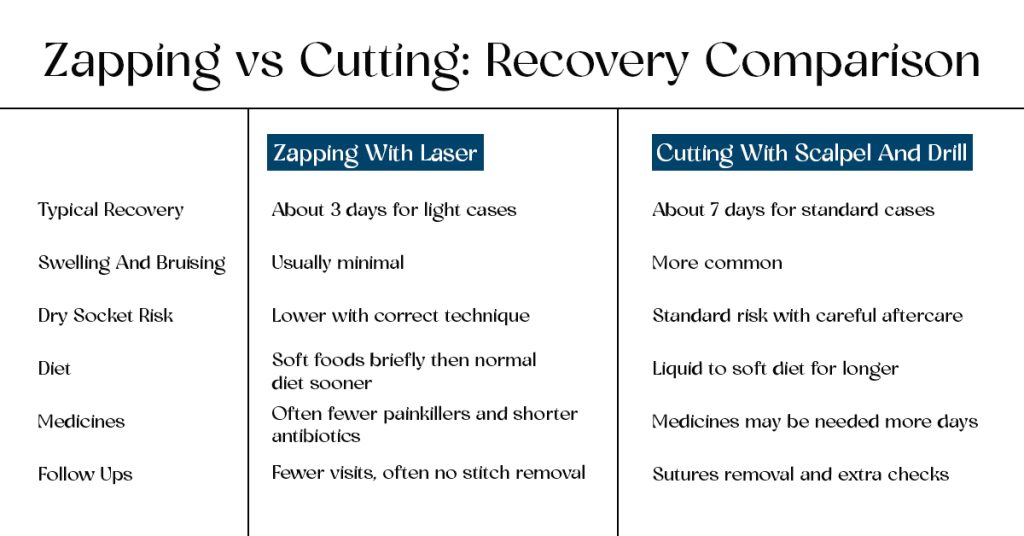
- Often no sutures to remove.
- Fewer follow ups.
- Earlier clearance for gym, work, and travel when the surgeon approves.
Cutting leaning differences
- Sutures removal appointment.
- Soft diet for longer.
- Closer checks for swelling, bruising, or signs of infection.
Decision Guide: Pick Your Path In 60 Seconds
- Want minimal bleeding, less swelling, and a quicker recovery for a soft tissue heavy case. Consider zapping.
- Have a fully impacted lower wisdom tooth in dense bone and want the most predictable removal at a practical cost. Consider cutting.
- Have mixed factors. We may use a hybrid approach that blends laser and traditional steps.
Why Asian Dental Is A Safe Choice For Either Method?
Whether you need laser accuracy or traditional mastery, it helps to have both under one roof. At Asian Dental, our oral surgeons use soft tissue laser, modern drills, OPG and CBCT imaging, and hospital grade sterilisation. We match the method to your X-ray, comfort needs, and recovery timeline, then support you with clear aftercare.
Many families choose us as the best dental hospital in Hyderabad and trust our team as the best dental clinic in Kondapur for wisdom teeth removal and precision dentistry.
Book A Consultation At Asian Dental Now!
Bring previous X-rays if you have them. If not, we will take new images and map your plan. You will leave with a written quote, a step by step explanation, and a realistic recovery timeline.
Kondapur: +91 99592 87499 | Kukatpally: +91 91002 50777
FAQs:
Is laser zapping safer than cutting?
Both are safe when matched to the right case. Lasers can reduce bleeding and swelling for soft tissue work.
Do lasers always avoid stitches?
Often yes for soft tissue. Complex extractions may still require sutures.
How many days off will I need?
Laser cases usually feel comfortable in about three days. Traditional cutting often needs about seven days.
Can I choose a laser for a fully impacted lower wisdom tooth?
Traditional cutting is usually preferred. A laser can still help with soft tissue steps.
Is cutting cheaper and covered by insurance?
Often yes. Many plans recognise traditional surgical codes in hospital settings.
Will either method prevent dry socket?
Good technique and aftercare reduce risk. No method is risk free.
Can I travel within a week after surgery?
Laser cases commonly yes after review. Traditional cases usually after the first check.
Do I need general anesthesia?
Most cases are comfortable with local anaesthesia. Sedation or general anaesthesia is reserved for complex or anxious cases.
Does laser reduce infection risk?
Coagulation and a tidy field help lower risk. Standard hygiene and aftercare still matter.
Which method heals faster if I need to return to work quickly?
For suitable cases, zapping typically offers shorter recovery and less discomfort.